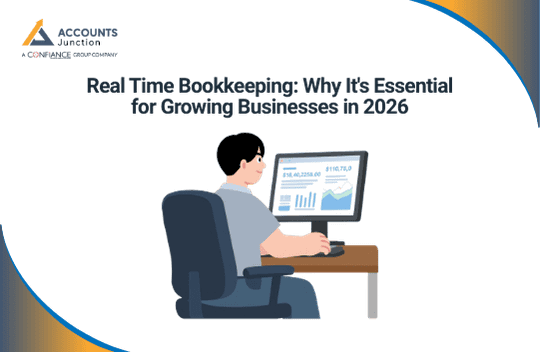
Real Time Bookkeeping: Why It's Essential for Growing Businesses in 2026
Real time bookkeeping has become a smart choice for many growing businesses. Many small and mid-sized firms face delays in their financial tracking.
Real-time bookkeeping can help make decisions quickly. It allows owners to focus on growth while staying on top of their finances. Growing businesses often find that traditional methods cost more in missed opportunities than real-time bookkeeping solutions.
Many owners ask, Why is real-time bookkeeping essential now? This blog explains the benefits, trends, and how to implement real-time bookkeeping in 2026.
If you’re running a growing business, you already feel it. Things move faster than they used to. Sales cycles are shorter. Expenses shift quickly. Clients delay payments without warning. Vendors raise prices mid-contract. Markets react overnight.
And yet, some companies are still waiting until the end of the month to see where things stand.
That delay used to be inconvenient.
Now it’s expensive.
Waiting three weeks to understand your cash position in 2026 is like driving while looking only in the rearview mirror. You’re technically moving forward. But you’re reacting to what already happened.
That’s where real time bookkeeping changes the conversation.
At Accounts Junction, we’ve worked with growth-stage businesses across the US, UK, Australia, and Canada that were technically profitable but constantly stressed about cash. Not because revenue was low. Because visibility was delayed.
Once they shifted to real-time bookkeeping, decision-making became calmer. More deliberate. Less reactive.
This isn’t hype. It’s operational clarity.
Let’s talk about why it matters now more than ever.
Why Growing Businesses Choose Real Time Bookkeeping in 2026
Growth sounds exciting-and it is-but it adds layers of complexity fast.
More transactions.
More vendors.
More payroll lines.
More tax exposure.
More moving parts.
Traditional bookkeeping systems operate in batches. Transactions pile up. Reconciliations happen at month-end. Reports are prepared days or weeks later.
That lag creates blind spots.
With real time bookkeeping, transactions flow in automatically through bank feeds. Expenses get categorized continuously. Dashboards update live. Reconciliations aren’t a once-a-month scramble-they’re ongoing.
Instead of asking, How did we do last month?
You’re asking, What’s happening right now?
That shift alone explains why real-time bookkeeping is becoming standard for scaling companies.
There’s also the remote work factor. Teams are distributed. Decision-makers are not always in the same office. Cloud systems allow everyone to see the same financial picture instantly.
Businesses that stick with manual or delayed processes often don’t realize how much friction they’re tolerating.
Until they switch.
One SaaS client we worked with reduced cash flow surprises by 25% simply because slow-paying customers were flagged immediately instead of weeks later. That’s the kind of impact real-time bookkeeping quietly delivers.
Real Time Bookkeeping Benefits for Growing Businesses
Let’s move past theory and talk about outcomes.
Faster, Smarter Decisions
When reports lag, decisions lag.
With real time bookkeeping, you can open your dashboard and see:
- Current cash position
- Accounts receivable aging
- Expense spikes
- Vendor payment schedules
- Profit trends
Continuous accounting for small businesses keeps the data fresh. You’re not guessing. You’re responding to live information.
We’ve seen businesses reduce reactive decisions by nearly a third after implementing structured real-time bookkeeping workflows.
Lower Operational Costs
Manual month end closes often take 10 to 20 days. That’s time spent chasing entries, fixing mismatches, and reviewing incomplete data.
Real time bookkeeping compresses that window dramatically. Because reconciliations happen continuously, month-end becomes confirmation, not reconstruction.
Businesses save thousands annually in labor and correction costs. Outsourced models amplify that savings, often reducing total finance overhead by 40–60% compared to in-house teams.
It’s not about cutting corners. It’s about eliminating inefficiency.
Better Cash Flow Control
Cash flow anxiety usually comes from delayed awareness.
You don’t see a pattern of late payments until it’s a problem. You don’t notice rising vendor costs until margins tighten.
Real time bookkeeping surfaces those trends immediately.
Growing businesses that adopt it often avoid 20–30% of common short-term cash crunches simply because they see issues earlier.
That’s not dramatic. It’s preventative.
Scalability Without Hiring Spikes
When transaction volume jumps from 500 to 2,000 per month, traditional systems strain.
Hiring more staff isn’t always the right answer.
Real time bookkeeping systems scale with transaction volume. Continuous accounting for small businesses adjusts workflows without adding layers of manual oversight.
Growth shouldn’t automatically mean more administrative burden.
Compliance Confidence
Tax regulations evolve constantly. Payroll rules change. Nexus thresholds shift.
With real-time bookkeeping, potential compliance issues surface sooner. That reduces penalties and audit risk.
We’ve seen clients cut penalty exposure by more than half simply because their books stayed continuously accurate instead of being periodically updated.
Common Accounting Challenges for Small Businesses - And How Real Time Bookkeeping Helps
Let’s be honest. Growing businesses face predictable friction points.
Delayed Insights
Monthly closing cycles create blind spots.
Real time bookkeeping eliminates that lag. You see patterns developing before they become expensive.
Manual Errors
Humans get tired. Repetition invites mistakes.
Automation inside real-time bookkeeping platforms handles the majority of recurring transactions, flagging anomalies for review instead of requiring manual entry every time.
That shift alone can reduce annual correction costs significantly.
Compliance Complexity
State and international tax requirements evolve. Remote teams introduce new variables.
Continuous accounting for small businesses ensures tax-relevant transactions are captured properly as they occur, not reconstructed later.
Growth Pressure
Manual systems don’t scale well.
Real-time bookkeeping adapts to transaction increases automatically. Structured rules and AI categorization prevent backlog buildup.
Remote Collaboration Issues
Disconnected spreadsheets don’t work for distributed teams.
Cloud-based real-time bookkeeping allows owners in New York, managers in London, and support teams in Ahmedabad to work within the same live environment.
Visibility builds alignment.
How Remote Real Time Bookkeeping Supports Growth
Growth rarely happens in one location anymore.
Remote teams need shared clarity.
Real-time bookkeeping provides shared financial visibility without geographic limitations.
At Accounts Junction, our Ahmedabad-based team supports US, UK, Australian, and Canadian businesses in real time. Transactions don’t wait for time zones. Dashboards remain updated continuously.
Continuous accounting for small businesses works especially well in remote models because reconciliation never pauses.
The result? Faster responses. Cleaner month-end cycles. Fewer surprises.
AI and Cloud in Real Time Bookkeeping
AI isn’t replacing finance teams. It’s removing repetition.
Inside modern real time bookkeeping systems, AI handles:
- Auto-categorization
- Duplicate detection
- Anomaly alerts
- Forecast modeling
Platforms like Sage offer advanced tools such as Sage Intacct that support multi-entity accounting, automation layers, and real-time dashboards.
Sage Intacct for accountants is particularly useful for businesses expanding across locations or revenue streams.
Cloud infrastructure adds another layer: security and accessibility.
When properly configured, real time bookkeeping environments are encrypted, access-controlled, and audit-ready.
Technology isn’t the trend. It’s the baseline now.
Step-by-Step Guide to Implementing Real Time Bookkeeping
- Assess Needs - Review delays, errors.
- Choose Tool - QuickBooks, Xero, Sage Intacct.
- Set Up Feeds - Connect banks.
- Automate Rules - AI categorizes.
- Integrate Apps - CRM, e-commerce.
- Add Oversight - Outsource exceptions.
- Monitor - Adjust quarterly.

Common Mistakes in Real Time Bookkeeping and Solutions
- Over-Automation - AI misses nuances. Solution: Human review.
- Poor Tool Choice - Wrong fit. Solution: Match size.
- Ignoring Security - Data risks. Solution: SOC 2.
- Skipping Training - Underuse. Solution: Learn the basics.
- Delaying Start - Missed benefits. Solution: Pilot now.
Accounts Junction: Your Partner for Real-Time Bookkeeping
At Accounts Junction, we implement structured real-time bookkeeping systems tailored to growth-stage businesses.
Our team blends automation with oversight. Continuous accounting for small businesses is central to our model.
We configure tools like Sage Intacct for accountants when complexity requires it, and scale solutions appropriately.
The Ahmedabad advantage allows cost efficiency without sacrificing compliance standards.
Clients typically experience:
- 40–60% cost savings
- Faster close cycles
- Improved reporting accuracy
- Reduced compliance exposure
But more importantly, they experience less uncertainty.
Future of Real Time Bookkeeping in 2026
By the end of 2026, real-time bookkeeping won’t be considered advanced. It will be expected.
AI will handle the majority of routine categorization. Forecasting will become more predictive. Dashboards will be fully dynamic.
Continuous accounting for small businesses will shift from a competitive advantage to an operational standard.
The only real question is whether you adopt early or catch up later.
Ready to Get Real Time Bookkeeping with Accounts Junction?
If delayed reporting is slowing your growth, real-time bookkeeping isn’t just helpful-it’s necessary.
At Accounts Junction, we specialize in real time bookkeeping and continuous accounting for small businesses across the USA, UK, Australia, and Canada. We configure, monitor, and manage systems so you stay focused on expansion.
Get a free consultation and 6-hour trial today. See real-time bookkeeping in action.
Contact us through our website or [email protected]. We respond within one business day.
Your business deserves financial clarity that moves as fast as you do.
FAQs
- What is real time bookkeeping?
It’s a system where transactions are recorded and reconciled continuously, providing live financial visibility. - Is continuous accounting for small businesses affordable?
Yes. Many outsourced models start around $1,000 per month and often reduce overall costs significantly. - Why use Sage Intacct for accountants?
It provides advanced automation, multi-entity support, and real-time reporting suited for scaling businesses. - How do I start real-time bookkeeping?
Select the right software, connect feeds, automate recurring entries, and add structured oversight. - Is real-time bookkeeping secure?
When properly configured with encryption and access controls, yes.