Bookkeeping vs Accounting: What Small Businesses Need to Know
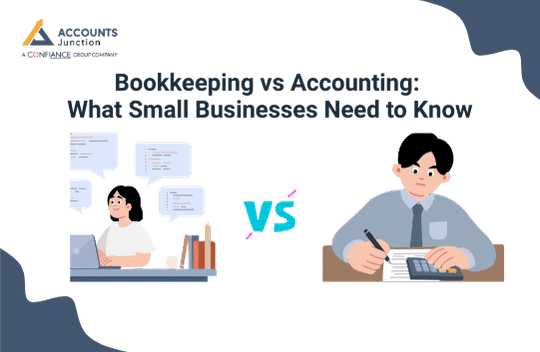
Bookkeeping vs Accounting: What Small Businesses Need to Know
Bookkeeping vs accounting has become a key question for many small business owners. Many small firms struggle with understanding the difference.
Knowing bookkeeping vs accounting can help make better decisions fast. It lets owners focus on growing the business while managing finances correctly. Small businesses often find that confusing bookkeeping vs accounting costs more in errors and time.
Many owners ask, What is the difference between bookkeeping and accounting? This blog explains accounting vs bookkeeping, the key roles, and why small businesses need to know in 2026.
If you run a small business, you already know money moves fast. Sales come in, bills go out, subscriptions renew, payroll hits, vendors get paid, taxes creep up. The financial side of your company never really pauses.
But here’s where things get messy: people throw around the terms bookkeeper and accountant like they mean the same thing.
They don’t.
And misunderstanding bookkeeping vs accounting is one of the quiet reasons small businesses make avoidable mistakes.
I’ve worked with business owners who thought their accountant was handling everything, only to discover months later that no one was actually reviewing profitability trends. I’ve seen others rely only on bookkeeping reports without deeper analysis, then wonder why cash flow kept surprising them.
The difference matters.
At Accounts Junction, we’ve helped businesses across the US, UK, Australia, and Canada sort through this exact confusion. Once owners understand bookkeeping vs accounting, they make smarter hires, choose better outsourcing partners, and stop expecting one role to cover both magically.
Let’s break this down in practical, real-world terms.
What Is Bookkeeping? The Foundation of Your Finances
If your business finances were a house, bookkeeping would be the concrete slab underneath it.
Bookkeeping is about recording what actually happened. No interpretation. No strategy. Just accurate tracking.
For small businesses, that typically includes:
- Recording sales and payments
- Logging expenses
- Categorizing transactions
- Reconciling bank and credit card accounts
- Tracking who owes you and who you owe
- Maintaining the general ledger
It’s routine. It’s detailed. It’s ongoing.
In 2026, bookkeeping is largely digital. Tools like QuickBooks and Xero automate bank feeds and recurring categorization. AI can correctly classify 80–95% of repeat transactions.
But here’s my slightly opinionated take: software doesn’t eliminate the need for clean bookkeeping. It just speeds it up.
If bookkeeping isn’t accurate, accounting becomes guesswork.
Small business owners often start doing their own bookkeeping. At 50 transactions a month, it feels manageable. At 500 transactions a month, it becomes a time sink. And errors start creeping in.
That’s where understanding bookkeeping vs accounting begins to matter.
Bookkeeping builds the data. Accounting relies on it.
What Is Accounting? The Big Picture Analysis
Now let’s zoom out.
If bookkeeping is recording the numbers, accounting is interpreting them.
Accounting takes that raw transaction data and asks:
- Are we profitable?
- Are expenses rising too fast?
- Is cash flow sustainable?
- Are we paying more tax than necessary?
- Can we afford to hire?
That’s the difference between accountant and bookkeeper in a nutshell.
Bookkeeper's document. Accountants diagnose and advise.
Accounting responsibilities often include:
- Preparing financial statements
- Analyzing profitability trends
- Budgeting and forecasting
- Tax planning
- Strategic advisory
- Compliance review
In 2026, AI can assist with forecasting and anomaly detection. But accounting still requires human judgment. Strategy isn’t automated.
This is where accounting vs bookkeeping becomes more than semantics. If you rely only on bookkeeping, you get an accurate history. If you add accounting, you get direction.
I’ve seen businesses run for years with clean books, but no one analyzing margins. Revenue grew, but profit shrank. They didn’t notice until cash tightened.
That’s what happens when bookkeeping vs accounting isn’t clearly understood.
Key Differences: Bookkeeping vs Accounting Explained
Let’s make this practical instead of theoretical.
Scope and Focus
- Bookkeeping is tactical. It ensures transactions are recorded correctly.
- Accounting is strategic. It uses those records to guide decisions.
- A bookkeeper records a $500 marketing expense.
An accountant asks whether that $500 generated $2,000 in revenue. - That’s a different level of thinking.
Skills and Qualifications
- Bookkeeping requires precision and consistency. Many trained professionals or certified software users handle it.
- Accounting typically requires advanced training, often from CPAs or experienced finance professionals.
- The difference between an accountant and a bookkeeper is similar to the difference between a technician and an analyst. Both are valuable. They just serve different functions.
Timing
- Bookkeeping is continuous, daily, or weekly.
- Accounting tends to be monthly, quarterly, or annual. It’s reflective and forward-looking.
- Confusing the two can create reporting gaps.
Tools
- Bookkeeping runs inside platforms like QuickBooks, Xero, or Zoho.
- Accounting often uses those same tools, but with deeper reporting layers and external compliance systems.
- AI is narrowing some differences, but not eliminating them.
Cost
- Bookkeeping outsourcing often ranges from $800–$2,000 per month, depending on volume.
- Accounting services, especially advisory, may range from $1,500–$5,000 per month,h depending on complexity.
- Understanding bookkeeping vs accounting helps you budget properly instead of overpaying for services you don’t yet need, or underinvesting in strategy when growth demands it.
When Small Businesses Need Bookkeeping vs Accounting
- Every business needs both. The balance shifts over time.
Early Stage (Under $500K Revenue)
- Clean bookkeeping is critical. Without it, chaos builds quickly.
- Accounting may be limited to tax filing support.
- This is where many founders underestimate the importance of bookkeeping vs accounting. They delay the structure, then pay for the cleanup later.
Growth Stage ($500K–$5M Revenue)
- Now accounting becomes essential.
- You need budgeting. Forecasting. Tax planning. Margin analysis.
- Bookkeeping remains foundational, but accounting drives smarter decisions.
- One startup we worked with outsourced bookkeeping at $300K revenue. By $1M, they added accounting support and avoided $8,000 in tax penalties through proactive planning.
- That’s the value of understanding accounting vs bookkeeping early.
Mature Stage ($5M+ Revenue)
- At this level, you need full accounting oversight-possibly a controller or fractional CFO.
- Bookkeeping should be automated and stable. Accounting should be proactive.
- Waiting too long to upgrade accounting often results in stalled growth.
Common Mistakes in Bookkeeping vs Accounting for Small Businesses
I see the same patterns repeatedly.
- Using the terms interchangeably.
Owners assume their bookkeeper is providing analysis. They aren’t. - Doing everything manually.
Spreadsheets create hidden errors. - Waiting too long to outsource.
Founders become overwhelmed, and financial clarity suffers. - Choosing the wrong partner.
Poor communication leads to confusion. - Failing to integrate systems.
Disconnected tools prevent accurate reporting.

Benefits of Outsourcing Bookkeeping and Accounting for Small Businesses
Outsourcing allows you to combine both roles efficiently.
You gain:
- Lower cost compared to in-house hires
- Access to specialists
- Scalable support
- Time savings
- Reduced compliance risk
At Accounts Junction, our Ahmedabad-based team supports both functions. We handle daily bookkeeping, reconciliations, and structured accounting analysis.
Clients often save 40–60% compared to building an in-house finance team.
One service company saved $36,000 annually while gaining clearer monthly reporting and proactive tax planning.
Understanding bookkeeping vs accounting allows you to outsource intelligently instead of reactively.
How Accounts Junction Helps with Bookkeeping vs Accounting
We approach this practically.
- Bookkeeping:
Daily entries. Reconciliations. Clean ledgers. - Accounting:
Monthly financial statements. Tax coordination. Forecasting support.
Our model blends cost efficiency with US compliance standards.
The goal isn’t just doing the books. It’s giving owners clarity.
Once business owners truly understand bookkeeping vs accounting, they stop feeling confused about their numbers. They start feeling in control.
Future of Bookkeeping vs Accounting in 2026
Automation will continue to handle more bookkeeping tasks.
AI will categorize transactions, flag anomalies, and speed reconciliation.
Accounting, however, will become more strategic, not less.
As systems automate routine work, financial professionals will spend more time advising on growth, profitability, and risk management.
Businesses that clearly define bookkeeping vs accounting roles now will adapt faster to those changes.
Those who blur the lines will struggle with gaps.
Ready to Optimize with Accounts Junction?
If confusion around bookkeeping vs accounting is slowing your decisions, it’s time to simplify.
At Accounts Junction, we specialize in bookkeeping vs accounting solutions for small businesses across the USA, UK, Australia, and Canada. We handle the routine work so you can focus on growth.
Get a free consultation and 6-hour trial today. See how bookkeeping vs accounting works when structured correctly.
Contact us via the website or email [email protected]. We respond within one business day.
FAQs
- What is the difference between bookkeeping and accounting?
Bookkeeping records transactions. Accounting analyzes and interprets financial data. - Accounting vs bookkeeping: Which do I need first?
Start with bookkeeping for accurate records. Add accounting for analysis and strategy. - Difference between accountant and bookkeeper?
Bookkeepers document financial activity. Accountants interpret it and provide advice. - Why outsource bookkeeping for small businesses?
It saves time, reduces errors, and often costs less than hiring in-house. - Can small businesses afford outsourcing?
Yes. Many services start around $800 per month and scale as needed.