Simplify Your Finances with Financial Tools
Managing finances can often feel confusing and stressful. But the use of financial tools may simplify this process, offering clarity and control. Whether for personal use or small business needs, these tools can help monitor spending, track income, and maintain records efficiently. With the growing number of options available, understanding which financial tools, accounting tools, and bookkeeping tools may suit your needs is important.
What Are Financial Tools?
Financial tools may be any software, app, or system that assists with managing money. They may track income, expenses, investments, or debts. Some tools can even forecast future spending patterns, helping people plan better. The idea is to reduce stress and allow smarter choices without extensive manual work.
- They may be digital or physical, but digital forms are most common.
- They can range from simple calculators to full-scale accounting platforms.
- They often integrate with bank accounts and credit cards for real-time updates.
By choosing the right financial tools, users may gain insights that were previously hidden in paperwork or spreadsheets.
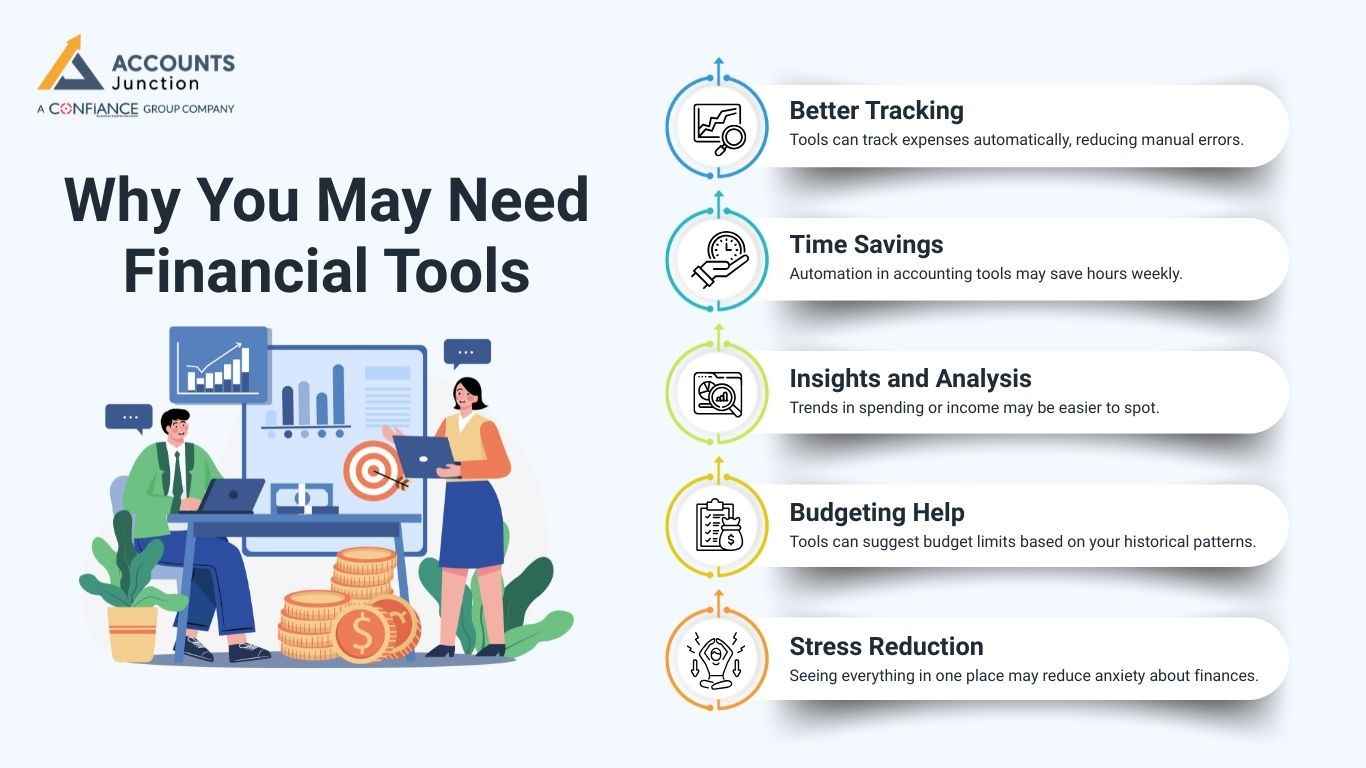
Why You May Need Financial Tools
Using financial tools can make life simpler, but not everyone may realize their potential. Some key benefits include:
-
Better Tracking
Tools can track expenses automatically, reducing manual errors.
-
Time Savings
Automation in accounting tools may save hours weekly.
-
Insights and Analysis
Trends in spending or income may be easier to spot.
-
Budgeting Help
Tools can suggest budget limits based on your historical patterns.
-
Stress Reduction
Seeing everything in one place may reduce anxiety about finances.
These advantages make financial tools appealing for both personal and professional use.
Types of Financial Tools You May Explore
There are several categories of financial tools, each serving a distinct purpose. Understanding them may help you choose wisely.
1. Accounting Tools
Accounting tools may focus on recording, summarizing, and reporting financial transactions.
- They can track invoices, payments, and receipts.
- Some accounting tools may generate reports for tax purposes.
- Businesses may use them to monitor profit and loss effectively.
Examples may include platforms like QuickBooks, Xero, and Wave, which provide cloud-based solutions.
2. Bookkeeping Tools
Bookkeeping tools are a subset of accounting tools but may focus primarily on daily transaction tracking.
- They may record income and expenses accurately.
- Some may provide bank reconciliation features.
- Small businesses often rely on them for simple record management.
By using bookkeeping tools, it is easier to maintain correct books without complex accounting knowledge.
3. Budgeting Tools
Budgeting tools may assist in planning future spending and saving goals.
- They may categorize spending automatically.
- Some may send alerts when spending exceeds set limits.
- Tools may also suggest better saving strategies.
Budgeting tools can often be part of a financial suite or standalone apps.
How Financial Tools May Help Small Businesses
Small business owners may find managing money challenging. Financial tools, accounting tools, and bookkeeping tools can provide several advantages:
- They may streamline invoice generation.
- Expenses may be tracked without manual spreadsheets.
- Tax preparation may become less stressful.
- Insights into cash flow may be more visible.
Integrating these tools with existing systems may reduce errors and free time for strategic planning.
How Financial Tools May Help Individuals
Even for personal finances, financial tools may offer major benefits:
- They can track bills and recurring payments.
- Investments and savings may be monitored in one dashboard.
- Some tools may provide visual reports for better understanding.
The consistent use of these tools may improve financial awareness and decision-making.
Choosing the Right Financial Tools
When selecting financial tools, consider your needs carefully:
1. Purpose
- Are you tracking personal expenses or business transactions?
2. Ease of Use
- Some tools may have steep learning curves.
3. Integration
- Can the tool connect with your bank accounts or payroll systems?
4. Cost
- Free options exist, but paid tools may offer more features.
5. Security
- Ensure the software uses strong encryption and secure access.
Trial versions may help you decide if a tool fits your workflow.
Tips for Effective Use of Accounting and Bookkeeping Tools
Even with great software, effectiveness depends on how you use it:
- Update records regularly to prevent a backlog.
- Categorize transactions for clearer reports.
- Reconcile accounts monthly to avoid errors.
- Backup data to prevent accidental loss.
- Explore features thoroughly; many tools may have hidden capabilities.
Regular attention may maximize the benefits of both accounting tools and bookkeeping tools.
Financial Tools and Tax Preparation
One key advantage of using financial tools may be simplifying tax preparation.
1. Categorizing Income and Expenses
-
Financial tools may automatically categorize income and expenses according to tax rules, making calculations easier.
2. Generating Tax-Ready Reports
- Some tools may generate reports formatted for submission to tax authorities, saving time and effort.
3. Reducing Errors and Missed Deductions
- Proper use of these tools may minimize mistakes and help ensure all eligible deductions are captured.
4. Supporting Professional Advice
- While tools can assist with preparation, consulting a tax professional may still be necessary for complex situations or audits.
Using these tools may streamline the tax process, improve accuracy, and provide peace of mind during filing.
Common Challenges You May Encounter
While financial tools can help, challenges may still arise:
- Learning new software may take time.
- Automation may fail if data is entered incorrectly.
- Over-reliance may reduce understanding of financial fundamentals.
- Some tools may not cover specific local tax rules.
Being aware of these issues may help you address them proactively.
Future of Financial Tools
The evolution of financial tools suggests that AI and automation may play a larger role:
- Predictive analytics may forecast future expenses.
- AI may categorize transactions more accurately than humans.
- Integration with mobile apps may improve accessibility.
As tools evolve, staying updated may enhance financial management.
Integration with Other Business Systems
Modern financial tools often allow integration with other software. This can simplify processes and reduce duplication of work.
1. Payroll System Integration
- Integration with payroll systems may streamline salary processing, tax calculations, and compliance reporting.
2. Point-of-Sale (POS) System Integration
- Syncing with point-of-sale systems may automatically record sales, refunds, and related expenses.
3. Inventory System Integration
- Connecting with inventory systems may provide real-time insights into stock levels, costs, and valuation.
4. Customer Relationship Management (CRM) Integration
- Integration with CRM systems may help track client payments, outstanding invoices, and revenue trends.
5. E-commerce Platform Integration
- Linking with e-commerce platforms may automatically update orders, refunds, and online sales data in financial records.
Financial tools, accounting tools, and bookkeeping tools may simplify complex money management tasks. They may save time, reduce stress, and improve insight into finances. While challenges exist, regular use may make financial management smoother. By exploring different tools and using them effectively, both businesses and individuals may find financial clarity and confidence.
At Accounts Junction, we provide a wide range of services, including accounting, bookkeeping, and financial reporting tailored to your needs. Our team includes certified experts who ensure accuracy and reliability in every financial record. With advanced solutions and personalized support, partner with us to manage your finances efficiently.
FAQs
1. What are financial tools and how do they work?
- Financial tools are software or apps that help track expenses, manage cash flow, and organize finances efficiently.
2. How do accounting tools differ from bookkeeping tools?
- Accounting tools provide broader financial reports and analytics, while bookkeeping tools focus on recording daily transactions.
3. Can small businesses benefit from financial tools?
- Yes, small businesses can simplify invoices, manage expenses, and monitor cash flow using financial tools.
4. Are accounting tools suitable for startups?
- Yes, accounting tools help startups track financial performance, generate reports, and plan budgets effectively.
5. Can bookkeeping tools handle multiple accounts?
- Yes, bookkeeping tools often support multiple bank accounts, credit cards, and payment platforms for accurate record-keeping.
6. Are financial tools secure for business use?
- Most financial tools use encryption and secure login systems, but businesses should review security features before use.
7. How can accounting tools save time for small businesses?
- Accounting tools automate calculations, generate invoices, and prepare financial reports faster than manual methods.
8. Can financial tools track expenses automatically?
- Yes, many tools sync with bank accounts and credit cards to record expenses in real time.
9. Are bookkeeping tools helpful for tax preparation?
- Yes, bookkeeping tools organize records and generate statements, simplifying tax filing with an accountant.
10. Do financial tools support budget planning?
- Yes, financial tools categorize spending, track cash flow, and suggest budget limits based on historical data.
11. Can accounting tools generate financial reports automatically?
- Many accounting tools provide automatic profit, loss, and cash flow reports for quick insights.
12. Are bookkeeping tools suitable for freelancers?
- Yes, freelancers can manage invoices, track payments, and maintain expense records efficiently with bookkeeping tools.
13. Can financial tools integrate with other software?
- Yes, most financial tools integrate with accounting, payroll, and CRM software for seamless financial management.
14. Are mobile financial tools reliable for businesses?
- Mobile apps are convenient for on-the-go access, but it’s important to check security and backup options.
15. Can financial tools forecast future spending?
- Yes, some financial tools analyze past trends to predict future expenses and help plan budgets.
16. Are there free financial and bookkeeping tools available?
- Yes, many basic financial, accounting, and bookkeeping tools are free and sufficient for small business needs.
17. How often should I update my financial tools?
- Regular updates ensure accurate records, new features, and improved security in financial and accounting tools.
18. Can bookkeeping tools reduce errors in accounting?
- Yes, automated bookkeeping tools minimize manual entry mistakes and improve financial accuracy.
19. Can accounting tools track multiple currencies?
- Many modern accounting tools support multiple currencies, making them ideal for global businesses.
20. How do I choose the right financial tools for my business?
- Consider features like invoicing, reporting, bank integration, and ease of use when selecting financial tools.