
Keeping Work Practices Within IR35 for the UK
Understanding and following IR35 is very important for businesses and contractors in the UK. The law is designed to stop tax avoidance through false self-employment. If a contractor works like an employee, then they should pay tax like one. This is the main idea behind the IR35 UK rules.
If you are a business hiring contractors or a freelancer working for a client, then knowing how to stay within IR35 is important. In this article, we will explain how to stay compliant, what practices to follow, and what mistakes to avoid.
What is IR35?
IR35 is a UK tax law. It checks if a contractor is really self-employed or working as an employee in disguise. Many people set up limited companies and offer their services to one client. They take benefits of tax savings while still working like a regular employee. The government created IR35 to stop this.
If you fall inside IR35, it means you are seen as an employee for tax. You must pay income tax and National Insurance like a normal worker. If you are outside IR35, then you are treated as a self-employed person. You can pay yourself through dividends and save some tax.
Why IR35 Compliance Matters
If you don’t follow the IR35 UK rules, it can lead to trouble. Here’s why compliance is important:
- You may have to pay back taxes for past years.
- HMRC can add penalties and interest.
- Your business or personal name can suffer.
- You may lose contracts or face legal problems.
To avoid these problems, it is best to follow the correct practices and check your status clearly.
How to Determine IR35 Status
Checking IR35 status is not always easy. It depends on how you work and what your contract says. The following are a few important points to consider:
1. Control
- Who controls the work? If the client tells you when, where, and how to work, you may fall inside IR35.
2. Substitution
- Can you send someone else to do the job for you? If yes, this shows you are a true business and may be outside IR35.
3. Mutual Obligation
- Is the client required to give you work? Are you required to accept it? If yes, then it may be an employment-like relationship.
4. Financial Risk
- Do you bear the risk if something goes wrong? Do you have your own insurance? If yes, you may be working outside IR35.
5. Equipment
- Are you using your own tools or those provided by the client? Using your own tools may support your case for being outside IR35.
You can also use HMRC’s online CEST (Check Employment Status for Tax) tool. It gives a basic idea, but your working practices should always match the contract.
Best Work Practices to Stay Within IR35
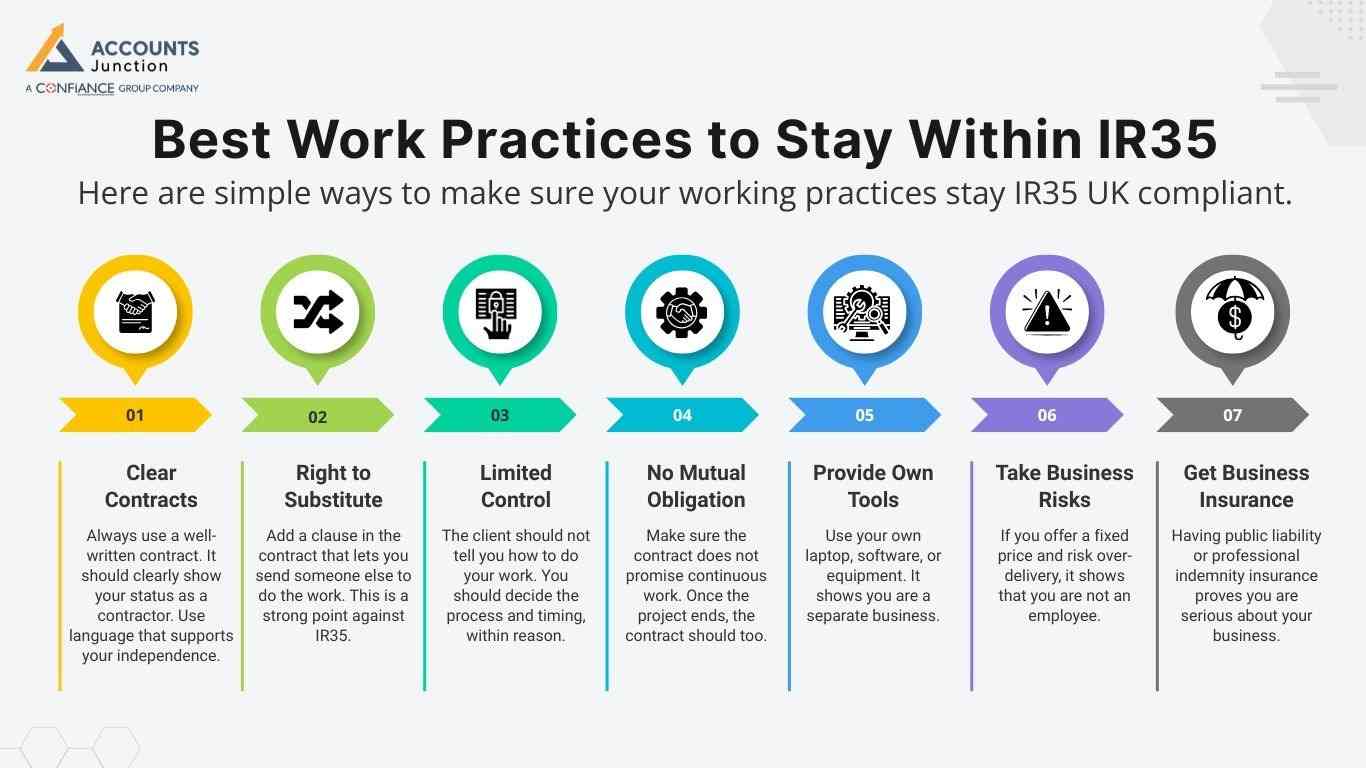
Here are simple ways to make sure your working practices stay IR35 UK compliant:
1. Clear Contracts
- Always use a well-written contract. It should clearly show your status as a contractor. Use language that supports your independence.
2. Right to Substitute
- Add a clause in the contract that lets you send someone else to do the work. This is a strong point against IR35.
3. Limited Control
- The client should not tell you how to do your work. You should decide the process and timing, within reason.
4. No Mutual Obligation
- Make sure the contract does not promise continuous work. Once the project ends, the contract should too.
5. Provide Own Tools
- Use your own laptop, software, or equipment. It shows you are a separate business.
6. Take Business Risks
- If you offer a fixed price and risk over-delivery, it shows that you are not an employee.
7. Get Business Insurance
- Having public liability or professional indemnity insurance proves you are serious about your business.
How Clients Can Stay Compliant
If you are a client hiring contractors, follow these tips:
- Provide a Status Determination Statement (SDS) for each contractor.
- Clearly state whether the contract is inside or outside IR35.
- Include the reasoning for the decision.
- Review contracts regularly and keep working practices in line.
Mistakes to Avoid
Many people make simple mistakes that can cause trouble under IR35 UK. Here are a few:
- Using the same contract for all contractors.
- Not matching the contract with real work practices.
- Letting the client control all aspects of the work.
- Using the company email or attending staff meetings like an employee.
- Staying with the same client for many years without changes.
These actions can make it look like employment. Always keep a line between employee behavior and contractor behavior.
Benefits of Being Outside IR35
Being outside IR35 has many key benefits for real contractors working through their own firm:
- It is easier to plan and handle taxes.
- More of the pay can come through dividends.
- Contractors have full control of their work and deals.
- There is more freedom to pick how, when, and where to work.
These perks only apply if one acts like a true contractor. To stay outside IR35 UK, it is key to stay clear of terms that look like a job role. Work style and contract must show that the business is free and not tied to the client’s rules.
The Role of Documentation in IR35
One thing that may often get ignored is documentation. Paperwork tells your story to HMRC.
- Keep copies of contracts, invoices, and communication records.
- Store proof that you take financial risk or manage your own work.
- Save receipts for business costs, tools, and insurance.
- Keep a clear paper trail that proves you operate as a business.
Having strong documentation can make the difference when your case is reviewed.
The Importance of Working Practices Over Words
Even if your contract says you’re outside IR35, your daily habits can tell another story.
- If you follow the client’s hours or take part in staff events, it may look like employment.
- Using the client’s desk, email, or tools can send the wrong signal.
- Try to set your own methods, timelines, and routines.
A smart contractor not only writes good contracts but also lives by them. Actions speak louder than written clauses.
Seeking Professional IR35 Support
IR35 rules can be confusing at times, and one wrong move can cost money. That’s why seeking expert advice early on may help you stay safe.
A qualified accountant or IR35 specialist can:
- Review your contracts and suggest corrections.
- Help you use the right wording and structure.
- Guide you through SDS and CEST results.
- Offer tax planning ideas suited to your status.
Sometimes, IR35 status can be hard to figure out. In these situations, seeking expert advice is recommended. Speak to a tax consultant or legal advisor. They can assess both your contract and your work practices. Getting help early can save you from problems later.
Staying compliant with IR35 UK is not hard if you follow the rules. Always remember that the contract and working style must match. Keep your business separate from your clients, take responsibility, and maintain your independence.
Whether you are a contractor or a client, being clear and honest helps avoid trouble. With the right practices, you can stay out of risk and keep your work running smoothly. If you need professional support, don’t wait for issues to arise. Accounts Junction provides reliable IR35 compliance services, contract reviews, and complete accounting solutions designed for contractors and businesses. Our certified experts ensure accuracy, compliance, and long-term financial stability. Partner with us to secure your business and future success.
FAQs
1. How can contractors keep their work practices within IR35 rules?
- By maintaining independence in how, when, and where they work and ensuring contracts reflect that setup.
2. What daily habits can make a contractor fall inside IR35?
- Working fixed hours, taking directions from the client, or joining staff activities can appear like employment.
3. Can unclear contracts lead to IR35 problems?
- Yes, vague contracts that don’t show independence can put you at risk of being classed inside IR35.
4. How often should contractors review their IR35 compliance?
- It’s smart to review it yearly or whenever project terms or clients change.
5. Does using client tools affect IR35 status?
- Yes, using your own laptop, software, or gear helps prove you run a real business.
6. How can clients help contractors stay IR35 compliant?
- By giving clear Status Determination Statements and avoiding control over daily work.
7. What signs may show that a contract is outside IR35?
- Right to substitution, control over work style, and financial risk often indicate outside status.
8. Can long-term work with one client cause IR35 trouble?
- It might, especially if the relationship looks like full-time employment.
9. How can contractors prove they’re independent under IR35?
- Keep evidence of business insurance, invoices, and multiple client work.
10. What should be included in a contractor’s IR35-friendly contract?
- Clauses for substitution, limited control, and no ongoing work obligation.
11. Can IR35 apply to short projects?
- Yes, even short-term contracts can fall inside IR35 if control and terms look like a job.
12. What are the biggest IR35 compliance mistakes contractors make?
- Letting clients control work or not matching the contract to actual practices.
13. How can professional advisors help with IR35 compliance?
- They can review your contract, assess work style, and give risk-free advice.
14. Does remote work automatically keep contractors outside IR35?
- No, even remote setups can fall inside if control or obligations resemble employment.
15. What kind of insurance supports IR35 compliance?
- Professional indemnity and public liability insurance show business responsibility.
16. How can businesses ensure fair IR35 assessments for contractors?
- By assessing each case individually and not using a one-size-fits-all SDS.
17. What happens if a contractor disagrees with the client’s IR35 decision?
- They can appeal with evidence and ask for a full review of work terms.
18. How do business risks affect IR35 status?
- When you face risk—like unpaid time or rework—it shows you’re not a regular employee.
19. Can IR35 status change during a project?
- Yes, if work conditions or control levels shift, your IR35 position may change too.
20. Why should contractors document their working practices?
- Records of control, risk, and independence can protect you during HMRC checks.
21. How can companies avoid IR35 disputes with contractors?
- By being transparent, reviewing SDS reports, and keeping consistent practices.
22. What benefits do contractors get from staying outside IR35?
- They gain tax flexibility, full work control, and more freedom to choose projects.
23. Who can help manage IR35 compliance for both clients and contractors?
- Firms like Accounts Junction offer expert IR35 contract reviews and compliance services.