
Comprehensive GST Guide for Importing Goods in Singapore
In Singapore, the Goods and Services Tax (GST) is an indirect tax on the supply of goods and services consumed within the country. The tax should also be applied to imported goods. This helps keep fair competition between local and imported products. As Singapore is fast becoming a major international trade and logistics hub, a basic understanding of GST on imports for Singapore is essential for all businesses involved in importing goods, as well as returning travellers. This comprehensive GST guide for importing goods gives all the necessary information regarding basic requirements, compliance, and exemptions that are available for both businesses and individuals.
Knowing the GST on imports for Singapore inside out would work to your advantage and help you avoid costly pitfalls, whether you are a business importing goods for resale or a traveller bringing back items for personal use. Understanding GST is essential when bringing products into the country. This GST guide for importing goods provides clear steps to stay compliant. This GST guide for importing goods helps you follow tax rules, avoid penalties, and stay compliant. Whether you're a small trader or a large business, this GST guide for importing goods gives step-by-step help.
Introduction to GST on Imports in Singapore
From January 1, 2024, Singapore charges 9% GST on all imports. This applies to both personal and business goods. The tax is based on the full value of the goods, including shipping, insurance, and related fees. This total is called the CIF value (Cost, Insurance, and Freight).
Key Compliance Requirements for GST on Imports
1. GST-Registered Businesses
To claim this input tax, your business must meet the following criteria:
- The goods must be used for business purposes. Personal items cannot be used to claim back GST.
- Documentation must be in place, including purchase invoices and any other supporting documents evidencing GST paid on imports.
- The invoices must fulfill IRAS requirements for GST-registered businesses, such as a description of the supplier and a breakdown of the total GST charged.
2. Personal Imports and GST Relief for Travellers
GST applies when individuals bring goods into Singapore for personal use. However, travellers can get relief based on the time they have spent outside the country. This relief is meant to offer some respite for personal purchases made while abroad.
GST Relief for Travellers
- If you have been outside Singapore for less than 48 hours, you can claim relief on purchases up to S$100.
- If you stay abroad for 48 hours or more, you can claim up to S$500 relief on goods bought for personal use.
GST relief applies only if the goods brought back are for personal use. If the goods are for resale, GST must be paid, no matter how long the traveler has been away.
Also, controlled items like alcohol, tobacco, and other restricted goods are not eligible for GST relief.
Example:
Suppose you spend S$1,200 on goods while in a foreign country for more than 48 hours, you will be allowed a S$500 relief. The remaining S$700 will then be subject to the GST, 9% of which will amount to S$63.
Step-by-Step GST Guide for Importing Goods into Singapore
Importing goods into Singapore can be smooth if you follow the right process. This GST guide for importing goods explains each step in a simple way so that businesses and individuals can stay compliant.
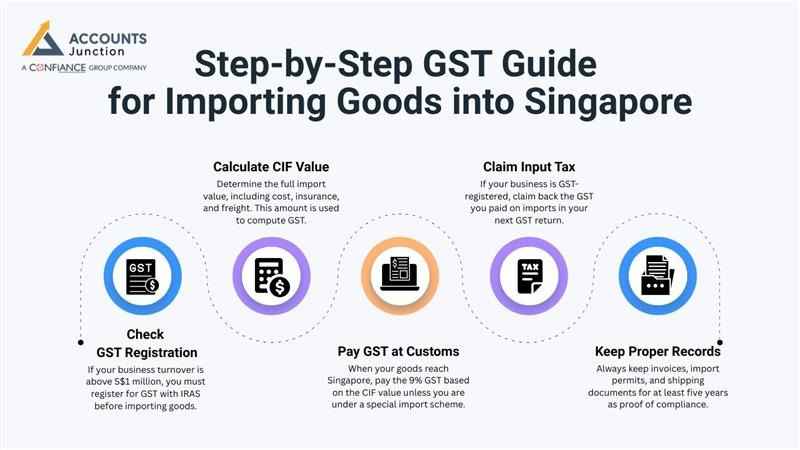
- Check GST Registration: If your business turnover is above S$1 million, you must register for GST with IRAS before importing goods.
- Calculate CIF Value: Determine the full import value, including cost, insurance, and freight. This amount is used to compute GST.
- Pay GST at Customs: When your goods reach Singapore, pay the 9% GST based on the CIF value unless you are under a special import scheme.
- Claim Input Tax: If your business is GST-registered, claim back the GST you paid on imports in your next GST return.
- Keep Proper Records: Always keep invoices, import permits, and shipping documents for at least five years as proof of compliance.
Claiming GST on Imported Goods for Businesses
In the case of importing goods for business purposes, following this GST guide for importing goods will help you get back the GST paid without errors. A proper GST guide for importing goods makes the process smooth. Here is the overview of the process:
1. Purchase Invoice Requirement
- To claim GST, your business needs an invoice. The invoice should list the goods' value, the GST charged, and any shipping or insurance costs.
2. GST-Compatible Invoice
- The invoice from your supplier must be GST-compatible. It should clearly show the GST amount and follow the format set by IRAS. The invoice must also include the supplier’s name, address, and GST registration number.
3. Proper Documentation for Claiming Input Tax
- Your business must ensure all the correct documentation is submitted during your GST return filing to ensure compliance. Failing to provide proper records can result in penalties or denial of input tax claims.
GST Relief for Personal Purchases
- To support travelers, the government offers GST relief based on time spent abroad. Here is a look at the exemptions for tourists and individuals:
Duration of Stay Abroad and Relief Amounts
- Less than 48 hours: GST relief of up to S$100 is available.
- 48 hours or more: GST relief of up to S$500 is granted.
Exclusions from GST Relief
Certain goods are not eligible for this relief. Items such as:
- Goods for commercial use (e.g., items intended for resale)
- Controlled goods like tobacco and liquor
These items are subject to the standard GST rate regardless of the time spent abroad.
Example:
If you spend S$1,500 on gifts and clothing during a month-long trip and return to Singapore, you can claim S$500 relief. This reduces the GST you pay to only S$1,000 worth of purchases.
Rebate on GST Paid on Inputs
A business registered for GST can claim credit for the GST paid on inputs such as raw materials. These materials are used in production.
If the credit is not claimed, the business will pay GST twice, once on the purchase and once on the sale.
Example of Claiming Input Tax:
If a company buys raw materials for S$1,000 and then pays S$90 in Goods and Services Tax, it shall claim back the S$90 in its GST return. This helps lower the company’s total tax cost.
Why Do I Have to Pay GST on Goods I Bring Into Singapore?
GST is imposed on goods and services consumed within Singapore and is levied on both domestic and imported goods. The goal is to ensure that all goods consumed within the country are taxed fairly. Without this system, local goods could be disadvantaged, and there could be disparities between domestic and international markets.
GST as an Indirect Tax
- GST is an indirect tax, unlike income tax. It is usually paid by the final buyer.
- But businesses must collect this tax and send it to the IRAS.
Relief for Returning Travellers
- The IRAS offers relief to travellers under specific conditions to alleviate the financial burden on personal purchases made abroad. By providing exemptions based on the duration of stay abroad, the government ensures fairness and recognizes personal consumption.
Example of GST Relief
- If a traveller has brought back goods upon return from a weeks-long holiday, the first S$500 worth of clothing and souvenirs would be exempted from GST. Hence, GST begins on additional S$300, resulting in a tax of S$27.
GST on imports for Singapore is important to understand for both entities in conduction of business and private individuals. The present GST rate is 9%. Businesses registered with a GST may claim a refund of GST paid on the import of goods. In other words, this benefits their cash flow, and it is in conformance with IRAN's legislative framework.
Travellers re-entering Singapore can be eligible for GST relief on imported goods for personal use. Such relief is dependent on the duration of stay outside of Singapore.
Correct documentation and adherence to rules are instrumental to being GST-correct. You can use this GST guide for importing goods to learn about input tax credit, import duties, and filing returns.
With the assistance of Accounts Junction, a business can face the GST process smoothly, ensuring compliance while improving tax positions.
FAQs
1. What is the GST rate for imported goods in Singapore?
- Singapore charges 9% GST on all imported goods, effective from January 1, 2024.
2. Does GST apply to personal items brought into Singapore?
- Yes, all imported goods for personal use are subject to GST, with relief depending on stay abroad.
3. What is the CIF value for GST calculation in Singapore?
- CIF includes the cost of goods, insurance, and freight, which is used to calculate GST on imports.
4. Who must pay GST on imported goods in Singapore?
- Both businesses importing goods for resale and travellers bringing personal items must pay GST.
5. Can travellers get GST relief on imported goods in Singapore?
- Yes, relief depends on stay abroad: up to S$100 for <48 hours, S$500 for ≥48 hours.
6. Which imported items are not eligible for GST relief in Singapore?
- Controlled goods like alcohol, tobacco, and goods for resale cannot receive GST relief.
7. How can businesses in Singapore claim GST on imported goods?
- GST-registered businesses must submit proper invoices showing GST paid, supplier details, and CIF value.
8. What documents are required to claim GST for imports in Singapore?
- Businesses need purchase invoices, shipping documents, and proof of GST payment for input tax claims.
9. What is a GST-compatible invoice for Singapore imports?
- An invoice following IRAS rules, listing supplier name, address, GST number, and GST amount.
10. How is GST calculated for personal imports in Singapore?
- GST is 9% of the total import value exceeding the S$100 or S$500 relief threshold.
11. Can Singapore businesses get a refund for GST on imported goods?
- Yes, registered businesses can claim back GST paid on imported goods used for business purposes.
12. Does GST in Singapore include shipping and insurance costs?
- Yes, the total CIF value, including shipping and insurance, is subject to GST.
13. Are gifts and souvenirs eligible for GST relief in Singapore?
- Yes, as long as they are for personal use and within the relief limits.
14. Does GST apply to imported goods purchased online abroad?
- Yes, all goods imported into Singapore, including online purchases, are subject to GST.
15. How can businesses avoid paying GST twice on imports in Singapore?
- By claiming input tax on imported goods, reducing GST payable during filing.
16. Are controlled imported goods always subject to GST in Singapore?
- Yes, items like alcohol and tobacco are taxed regardless of relief eligibility.
17. How do travellers claim GST relief at Singapore customs?
- Relief is applied automatically based on the value of goods and the time spent abroad.
18. Can GST relief for imported goods apply to business imports in Singapore?
- No, relief is only for travellers’ personal imports; businesses must claim input tax separately.
19. Why does Singapore charge GST on imported goods?
- To ensure fair taxation between local and imported products and tax consumption fairly.
20. What happens if businesses submit incorrect GST documents for imports in Singapore?
- Incorrect or missing invoices can lead to denied input tax claims or penalties from IRAS.
21. Can temporarily imported goods for trade shows get GST relief in Singapore?
- Businesses can apply for GST deferment schemes, but relief for temporary imports is limited.
22. How do I check if my imported goods qualify for GST relief in Singapore?
- Items must be for personal use, under the relief limit, and not controlled goods.
23. Can GST relief apply for multiple trips abroad in Singapore?
- Yes, relief is applied separately for each trip based on duration outside Singapore.
24. Does the GST relief in Singapore change with duration abroad?
- Yes, <48 hours gives S$100 relief; ≥48 hours gives S$500 relief.
25. Who can help me manage GST on imports in Singapore?
- Businesses can partner with experts like Accounts Junction to ensure compliance and proper GST claims.