.jpg_1762774032.jpg)
Best Real Estate Accounting Software 2026
When one thinks of property, money comes right after. Every rent received, every repair paid, every deal closed — all of it moves through numbers. Many who deal in property still depend on ledgers, papers, or old files tucked in drawers. But the year 2026 may not wait for slow hands. Things are shifting, faster than they ever did. Property businesses should now look for simple tools that save time, bring clarity, and keep their books breathing clean. In this blog, we will explore some of the best real estate accounting software you can choose in 2026.
What Real Estate Accounting Software Does
Real Estate Accounting Software is just a tool — a place where all your property income and spending live together. It can record rent, list maintenance costs, store tax details, note lease dates, and even remind you when a payment is due. It works as a smart digital ledger for the real estate world.
In short, it helps you see how money moves across your +buildings — what comes in, what goes out, and what may need your eye. But unlike a normal accounting program, this one understands property. It knows that one tenant may delay rent while another may renew a lease. It knows that property tax, repairs, and deposits are not just numbers but events that shape your books.
Why should you use real estate accounting software?
Let us pause and think: do you really need software for your property? Maybe you do, maybe you don’t. But it’s worth looking at what it can bring. Here’s why you should have a real estate accounting software:
1. Less confusion
- All payments, invoices, and expenses stay in one place. You no longer need to jump between files or apps.
2. Quick rent tracking
- You can check which tenant has paid, who hasn’t, and when the next due date may arrive.
3. Clear reports
- You can view cash flow, income statements, and profit per property without digging through papers.
4. Easy tax time
- At the end of the year, reports are ready. Your accountant may thank you for saving time.
5. Better growth
- When you see clear data, you can plan new deals with more sense.
What You May Look For in a Good Real Estate Accounting Software
Now that the idea sounds clear, what makes one software better than another? Here are some simple points that can help:
1. Property-based setup
- It should let you add each property separately, with all its details — tenant names, rent, repairs, deposit, and bills.
2. Automatic rent and reminders
- A good system send alerts when rent is due or late. Some may even send polite payment reminders to tenants.
3. Expense tracking
- From maintenance to paintwork, every cost should find a place under that property’s name.
4. Reports you can understand
- The numbers should make sense even if you are not an accountant. Simple graphs, plain words, and ready statements help.
5. Cloud and mobile access
- Life moves fast; so should your books. You may need to see data while traveling, so mobile apps matter.
6. Data backup and safety
- You don’t want your financial story to vanish in one click. The software must secure your data and allow backups.
7. Scalability
- Maybe you manage 3 units today and 30 next year. Your tool should grow with you without forcing a switch.
8. Integration with banks or payment apps
- If it can talk to your bank and auto-update transactions, that’s a gift.
9. Customer support that listens
- You may face issues at some point, so quick and human support may matter more than you think.
Top Real Estate Accounting Software in 2026
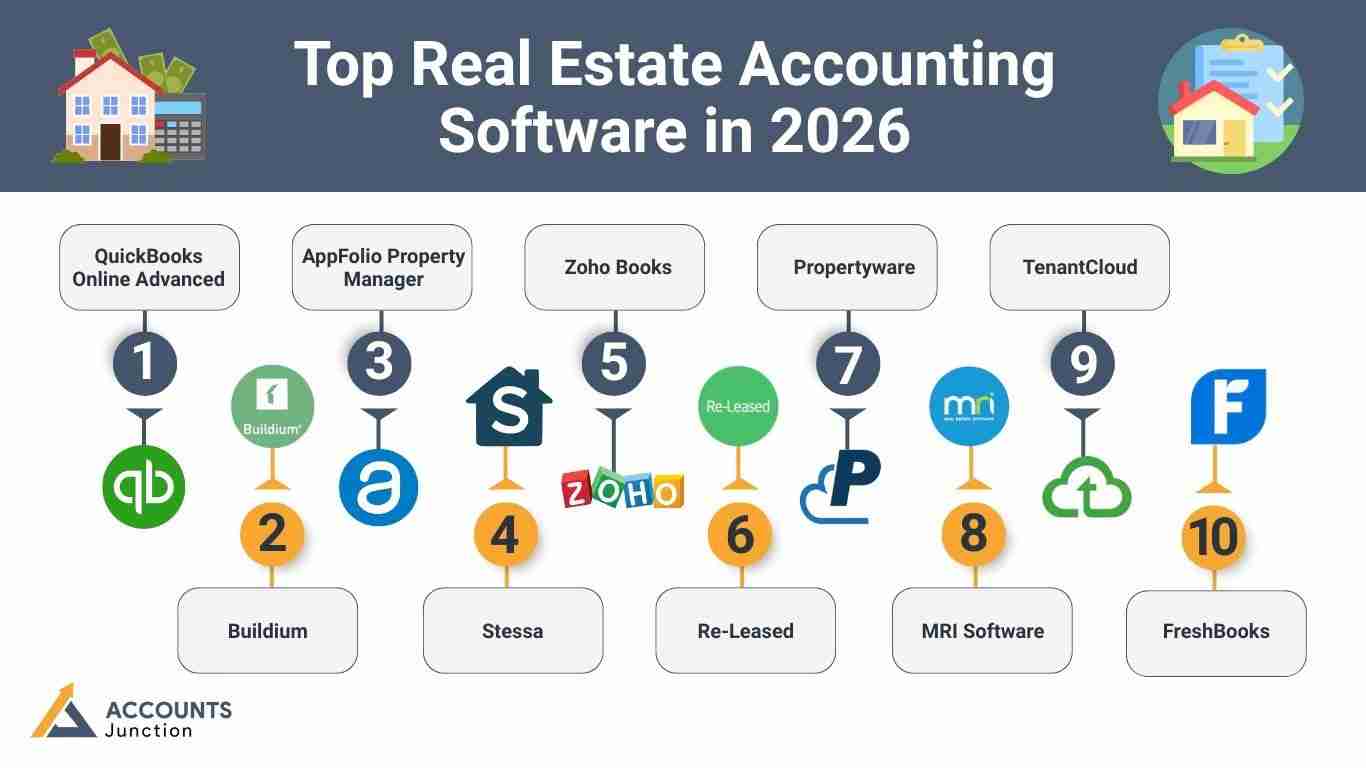
After seeing trends and feedback across markets, here are some names that may rise above others in 2026. Not ranked, just mentioned as options that may fit different needs. Here are some top real estate accounting software in 2026:
1. QuickBooks Online Advanced
QuickBooks may still hold its ground in 2026 for real estate firms. Its familiar layout and wide integrations make it a safe choice.
What makes it shine:
- Can manage commissions and property-based expenses
- Offers clean dashboards for portfolio views
- May link with property tools like Buildium and AppFolio
Who may find it best:
Small to mid-sized agencies and property managers who prefer trusted systems.
2. Buildium
Buildium may feel like a warm companion for property managers. It blends accounting and property operations under one roof.
Why people like it:
- Handles tenant payments, leases, and owner statements
- Offers online rent collection
- Creates real-time financial snapshots
Best for:
Property managers handling multiple units who need both control and comfort.
3. AppFolio Property Manager
AppFolio may serve those who dream of a full ecosystem. It handles accounting, property listings, maintenance, and even marketing.
Highlights include:
- In-built AI tools for smarter workflows
- Clear financial tracking for multiple properties
- Real-time data visualization
Ideal for:
Larger firms that manage diverse portfolios.
4. Stessa
Stessa feels like a calm space built for property investors. Its strength lies in simplicity and direct control.
Why it may stand out:
- Free version for smaller portfolios
- Can track income and expenses automatically
- Generates tax-ready reports
Best for:
Individual investors who want simple accounting without heavy fees.
5. Zoho Books
Zoho Books may look quiet but is surprisingly capable. It fits those who want customization and clean workflows.
What makes it special:
- Can integrate with Zoho CRM and Projects
- Allows automated payments and recurring bills
- Offers clear profit and loss tracking
Perfect for:
Real estate consultants or small agencies seeking flexibility.
6. Re-Leased
Re-Leased may sound like it belongs to the future — and maybe it does. Built for commercial property management, it merges finance and operations.
Why it feels futuristic:
- Real-time dashboards and alerts
- Lease tracking with financial summaries
- Cloud-based collaboration tools
Best suited for:
Commercial real estate firms with multiple stakeholders.
7. Propertyware
Propertyware may focus on customization and detail. Its accounting tools go deep into owner reporting and financial splits.
Features that help:
- Trust accounting support
- Maintenance and inspection tracking
- Owner portals for transparent updates
Good for:
Mid to large property firms needing precise control.
8. MRI Software
MRI Software has been around for years, yet it still evolves. Its open architecture means it can grow with your needs.
What may attract users:
- Strong reporting tools
- Easy integration with other real estate systems
- Deep analytics for asset management
Fits best for:
Enterprises or firms with complex portfolios.
9. TenantCloud
TenantCloud can serve landlords who handle their own properties. It brings accounting and tenant communication together.
Key offerings:
- Online rent collection
- Expense tracking
- Maintenance requests handled in one app
Best for:
Independent landlords and small managers.
10. FreshBooks
FreshBooks may not be a pure real estate software, but it can easily adapt. With smooth invoicing and clean layouts, it simplifies financial work.
What to expect:
- Time tracking for project-based deals
- Customizable reports
- Simple collaboration features
Ideal for:
Real estate consultants and freelancers.
How to Choose the best real estate accounting software
There is no perfect choice for everyone. It may depend on your business size, comfort with tech, and how many properties you manage. Here are a few guiding steps that may help you choose the best real estate accounting software:
- Start small. Try free trials before paying.
- Think ahead. Will the software handle more properties later?
- Look local. If you are in India, find one that fits GST and INR use.
- Ask questions. Talk to support before you buy.
- Check mobile features. Phones matter more than laptops these days.
- See reports. If they confuse you, that’s not your match.
- Plan migration. Move data slowly and test before going full.
- Train the team. Even the best software fails if no one learns it.
Common Mistakes to Avoid while choosing Real Estate Accounting Software
Here are some mistakes you may avoid while choosing Real Estate Accounting software:
- Picking software based only on cost.
- Ignoring training and support.
- Forgetting backup or security checks.
- Not mapping all property accounts before setup.
- Using personal accounts instead of business ones.
Avoiding these can save you from additional costs later.
The world is no longer using papers for accounting. Hence, as a real estate business owner, you should switch to using software for accounting. Choosing the best real estate accounting software can help your business flourish in 2026. At Accounts Junction, we help real estate businesses around the world with accounting services. Contact us now to know more about our real estate accounting services.
FAQs
1. What does Real Estate Accounting Software do?
- It may help track income, expenses, and rent payments while creating clean financial reports.
2. Can Real Estate Accounting Software manage tenant payments?
- Yes, many tools like Buildium or TenantCloud allow online rent collection and tracking.
3. Which Real Estate Accounting Software is best for small landlords?
- Stessa and TenantCloud may suit small landlords who prefer simple and direct systems.
4. Does Real Estate Accounting Software handle taxes?
- Some programs can create tax-ready statements, but users may still need review before filing.
5. Can such software integrate with CRMs?
- Yes, many connect smoothly with real estate CRMs to share property and client data.
6. Is cloud storage safe for real estate accounting?
- Reputed tools use strong encryption, though regular password changes may add safety.
7. What features should a property manager look for?
- Rent tracking, owner reporting, and maintenance logs often form the top list.
8. Can automation reduce manual work?
- It can. Features like auto-payments and recurring entries often save hours each week.
9. Which Real Estate Accounting Software is most scalable?
- Re-Leased and MRI Software may grow well with larger or expanding portfolios.
10. How much does real estate accounting software cost?
- Plans may start low for individuals but rise for full business features or multi-user access.
11. Can software track multiple properties at once?
- Yes, most tools support multi-property tracking with clear dashboards.
12. Is it hard to switch from old systems to new ones?
- It may take some setup time, but many platforms offer guided migration help.
13. Does every real estate agent need accounting software?
- Not all, but it can simplify recordkeeping and bring better clarity to earnings.
14. Can these tools help during audits?
- Yes, stored reports and transaction trails can make audits smoother and faster.
15. Do such systems work on mobile?
- Many modern versions come with mobile apps for rent collection and quick updates.
16. Can Real Estate Accounting Software predict profits?
- Some new tools in 2026 may use analytics to suggest potential income trends.
17. Which tool fits best for commercial property?
- Re-Leased or MRI may handle commercial leases and complex finances better.
18. Is QuickBooks still good for real estate in 2026?
- QuickBooks remains popular, especially with its property-focused integrations.
19. Can these tools send owner statements automatically?
- Yes, Buildium and Propertyware can generate and send owner statements with a click.