Which method of accounting is best for a construction company?
Managing finances in the construction industry is a complex task. It requires specialized knowledge of both construction business and accounting. Construction company accounting differs from standard business accounting due to factors like long-term contracts, job costing, fluctuating expenses, and revenue recognition complexities. To ensure financial stability and compliance, it is crucial to implement a structured approach to accounting for construction companies.
Construction projects involve multiple stakeholders, various cost elements, and different billing methods. Hence, bookkeeping for construction companies is essential to track costs, manage budgets, and ensure profitability. A good accounting system in place improves payroll, expense tracking, and cash flow management, boosting financial performance.
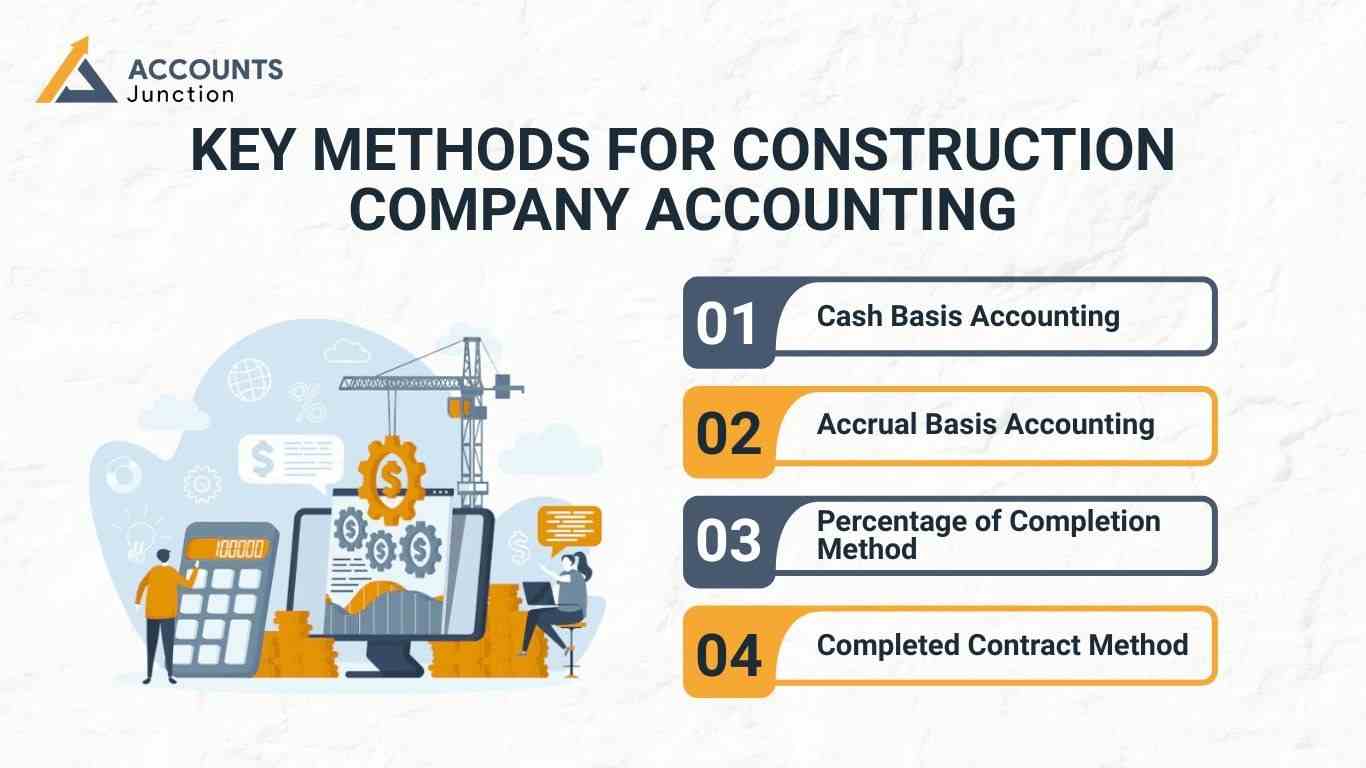
Key Methods for Construction Company Accounting
Accurate construction company accounting relies on selecting the right accounting method. Since construction projects often span multiple months or years, traditional accounting methods may not be sufficient. The most commonly used methods in accounting for construction company operations include:
- Cash Basis Accounting
- Accrual Basis Accounting
- Percentage of Completion Method
- Completed Contract Method
Each method offers distinct advantages and is chosen based on project duration, contract type, and financial reporting needs.
Cash Basis Accounting
Cash basis accounting is one of the simplest forms of bookkeeping for construction company operations. In this method:
- Revenue is recorded when cash is received.
- Expenses are recorded when payments are made.
- No accounts receivable or payable are recorded.
This method is beneficial for small construction companies with straightforward transactions. However, it may not provide an accurate financial picture for businesses managing multiple contracts simultaneously. Many companies prefer more detailed methods to track financial performance.
Accrual Basis Accounting
In accrual basis accounting, revenue and expenses are recorded when they are earned or incurred, regardless of cash transactions. This method ensures:
- A more accurate representation of financial status.
- Better matching of revenue with corresponding expenses.
- Improved financial planning and decision-making.
For businesses handling multiple projects with long payment terms, accrual accounting works better than cash basis. It provides a realistic view of financial performance, which is crucial for stakeholders and tax reporting.
Percentage of Completion Method
The percentage of completion method is widely used in construction company accounting, especially for long-term projects. In this approach:
- Revenue and expenses are recognized proportionally to the project's completion stage.
- Financial statements reflect work progress rather than waiting for project completion.
- Helps in smooth cash flow management.
This method provides a more accurate reflection of a company’s financial position, ensuring transparency and accountability. However, it requires precise tracking of project progress and cost estimates.
Completed Contract Method
The completed contract method records revenue and expenses only after project completion, unlike the percentage of completion method. This approach is ideal for short-term contracts or when revenue recognition is uncertain. Its key features include:
- Revenue is not recorded until project completion.
- Expenses are accumulated until the contract is finished.
- Ideal for tax deferral strategies.
This method simplifies bookkeeping for construction companies but can cause financial fluctuations since revenue is recorded only at project completion.
Tips to Improve Construction Accounting Efficiency
Better accounting doesn’t always mean more paperwork — sometimes, it’s about smarter processes. Companies can start by:
- Using cloud-based accounting tools to track projects in real time
- Setting clear budgets and cost codes for every job
- Reviewing reports monthly to catch irregularities early
- Training teams to record transactions accurately and on time
Even a small effort toward better organization may lead to stronger financial control and easier decision-making down the road.
Comparing Different Accounting Methods
Choosing the right accounting method is crucial for financial success in the construction industry. Below is a quick comparison of the most commonly used bookkeeping for construction companies methods:
|
Accounting Method |
Revenue Recognition |
Best for |
|
Case Basis |
When cash is received |
Small businesses, short-term projects |
|
Accrual Basis |
When earned |
Large businesses, long-term projects |
|
Percentage of Completion |
Based on the Project's progress |
Large-scale, multi-year projects |
|
Completed Contract |
At project completion |
Short-term contracts, tax deferral |
Pros and Cons of Each Method
1. Cash Basis Accounting
Pros:
- Simple to implement and maintain
- Records revenue and expenses only when money is received or spent.
- Helps with short-term cash flow management
Cons:
- Doesn't provide an accurate financial picture for long-term projects
- Revenue and expenses may not match the period in which they occur
- Not suitable for larger companies or those required to follow GAAP
2. Accrual Basis Accounting
Pros:
- Gives a clearer view of the company's financial status.
- Matches revenue with corresponding expenses, improving financial reporting
- Required for businesses following Generally Accepted Accounting Principles (GAAP)
Cons:
- More complex to implement and maintain
- Requires tracking accounts receivable and accounts payable
- Higher risk of reporting income before receiving payments, affecting cash flow
3. Percentage of Completion Method
Pros:
- Recognizes revenue and expenses as work progresses, ensuring accurate financial reporting
- Helps construction companies comply with tax regulations
- Provides better financial visibility for long-term projects
Cons:
- Complex to calculate and requires precise cost estimation
- Errors in estimating completion percentages can lead to inaccurate reporting
- Not ideal for smaller projects with short durations
4. Completed Contract Method
Pros:
- Defers tax obligations until project completion
- Simplifies accounting by recognizing revenue and expenses only when the project is finished
- Useful for short-term projects where costs and revenue are uncertain
Cons:
- Doesn't provide ongoing financial insights during the project
- Can create unpredictable cash flow issues
- Not suitable for large or long-term projects that require progressive revenue recognition
Why Choose Accounts Junction for Construction Company Accounting Services?
Expertise in Construction Accounting
- Specialized knowledge in construction company accounting, ensuring compliance with industry-specific financial regulations.
- Experience in managing financial complexities unique to accounting for construction company operations.
Accurate Bookkeeping and Financial Management
- Provides detailed bookkeeping for construction company records, ensuring accurate financial tracking.
- Manages project-wise financial records, tracking income and expenses efficiently.
Use of Industry-Specific Accounting Software
- Expertise in QuickBooks, Xero, Sage, and other accounting software tailored for construction company accounting.
- Ensures seamless integration with project management tools for real-time financial monitoring.
Custom Financial Reporting and Analysis
- Prepares customized financial reports, including profit & loss statements, balance sheets, and project-wise cost analysis.
- Helps in decision-making by providing detailed insights into profitability and cash flow management.
Tax Planning and Compliance
- Ensures compliance with local tax laws and regulations for accounting for construction company operations.
- Offers strategic tax planning to minimize liabilities and maximize deductions.
Effective construction company accounting is essential for maintaining financial stability, tracking project costs, and ensuring compliance with tax laws. Choosing the right accounting for construction companies method depends on your business structure, project type, and financial goals.
At Accounts Junction, we offer expert bookkeeping for construction companies to help contractors manage their finances efficiently. By selecting the right accounting approach, businesses can enhance cash flow management, optimize profitability, and achieve long-term growth.
FAQs
1. What makes construction accounting more detailed than regular business accounting?
- Construction accounting deals with project-based income and costs, which can change from job to job. It requires more tracking and judgment in every stage.
2. Can small construction firms manage accounting on their own?
- They may handle it for a while, but as projects grow, professional support can bring more accuracy and save time.
3. Why do long-term projects need special accounting methods?
- Because income and costs stretch over months or even years, timing becomes key. Regular methods might not show the true financial picture.
4. Is job costing really necessary for every project?
- It may not feel essential for smaller jobs, but even there, it can reveal insights about profit and waste that are often missed.
5. Can software tools make construction bookkeeping easier?
- Yes, many cloud tools today help track costs, invoices, and reports in real time. They also reduce errors that manual entries might create.
6. What happens if a company picks the wrong accounting method?
- It might still function, but reports may mislead decision-makers, and tax filings could become complicated.
7. How often should construction companies review financial reports?
- A monthly check can help, though bigger firms might review weekly to keep track of fast-moving expenses.
8. Can the percentage of completion method cause reporting errors?
- If progress is not tracked properly, yes. It depends a lot on accurate estimates and regular project updates.
9. Why do some contractors prefer the completed contract method?
- They like that it delays tax payments and keeps reporting simple until the job is fully done.
10.Does accrual accounting suit large construction companies better?
- Usually, yes. It matches income and expenses closely, giving a clearer view of how the business stands.
11. Can a construction company use more than one method?
- Sometimes they can. Some firms use cash for smaller jobs and accrual or percentage-based methods for bigger contracts.
12. What kind of reports help construction owners the most?
- Project-wise profit and loss, job costing summaries, and cash flow reports often guide the best decisions.
13. How can poor record-keeping affect a project?
- Even small mistakes may lead to overbilling, unpaid bills, or profit losses that are noticed too late.
14. Can modern accounting tools link with project management software?
- Yes, many tools can sync both sides, allowing managers and accountants to see live updates.
15. What’s the biggest mistake new construction firms make in accounting?
- Mixing project costs together or not tracking expenses separately for each job.
16. How does accurate bookkeeping help in tax planning?
- It allows companies to claim correct deductions, avoid penalties, and plan ahead for tax seasons.
17. Why might a company outsource construction bookkeeping?
- Outsourcing can save time, reduce overhead costs, and provide access to experts who understand industry rules.
18. Is it better to handle payroll internally or outsource it?
- It depends on the company size. Smaller ones may manage it in-house, but bigger ones often find outsourcing more reliable.
19. How can proper accounting improve bidding accuracy?
- By reviewing old project costs and outcomes, companies can make smarter estimates for new bids.
20. What’s the first step toward improving construction accounting?
- Start with organizing financial data by project and reviewing which method fits best with your business goals.