Why accounting in hospitality industry is very important?
In the hospitality industry, customer experience is considered supreme. Providing the best customer experience means covering all the aspects in your service. The hospitality industry often needs smooth operations with sustainability of the business. At Accounts Junction, we understand the importance of accounting in hospitality industry for achieving long-term success.
Importance of accounting in hospitality industry
The following shows the importance of accounting in hospitality industry:
Financial Health Check-Up: Understanding the Pulse of the Business
In the hospitality accounting, success is not just about creating memorable experiences; it's also about maintaining a healthy bottom line. The hospitality accounting serves as a vital diagnostic tool, providing real-time insights into the financial health of a hotel, restaurant, or any other hospitality establishment.
Budgeting and Cost Control: Crafting the Recipe for Financial Success
Successful financial management in the hotel industry, like a well-planned meal, necessitates careful thought. The accounting in hospitality industry acts as a chef, supporting firms in creating the ideal recipe for financial success. Businesses can discover areas where expenses can be cut without sacrificing quality by using smart budgeting and cost control.
Regulatory Compliance: Navigating the Complex Landscape
The hospitality accounting business is governed by a complicated web of rules and tax responsibilities. The accounting in hospitality industry serves as a compass, ensuring that organizations navigate the complex sea of compliance with ease. Staying on the right side of the law is critical in everything from tax reporting to labor rules, and accounting is the compass that helps firms navigate these seas.
Cash Flow Management: Keeping the Cash Flowing Smoothly
Cash flow is the lifeblood of any organization, and in the hotel industry, where expenses are sometimes incurred ahead of time, good cash flow management is a must. The accounting in hospitality industry software allows firms to forecast cash flow, allowing them to anticipate and deal with possible financial deficits. This foresight is critical for meeting operational costs, investing in improvements, and capitalizing on growth prospects.
Types of Accounting in Hospitality Industry
Here are the main types of accounting in hospitality industry:
1. Financial Accounting
Financial accounting in hospitality industry deals with clear and accurate reports for owners, investors, and regulators. Hotels, resorts, and restaurants rely on these statements to understand their real financial standing. It covers balance sheets, income statements, cash flow reports, and compliance needs. Since the industry handles large cash flow and daily transactions, clean records help leaders track profit, spot risk, and meet all legal rules with ease.
2. Managerial Accounting
Managerial accounting supports daily decisions inside a hotel or restaurant. Leaders use this data to plan budgets, check cost trends, and track how each unit performs. It answers questions like: Which room type brings the most margin? Are labor costs too high this month? Should we adjust menu prices? This type of accounting guides teams with simple insight that helps control waste, improve staff use, and shape long-term plans.
3. Cost Accounting
Cost accounting focuses on tight control of food, beverage, labor, and overhead. Since the hospitality field sees thin margins, even small waste can hit profit. This method helps track food portion cost, recipe cost, supply cost, and room service cost. It also shows the true cost of each product or service. With this insight, hotels and restaurants can cut waste, set smarter prices, and improve margins without hurting the guest experience.
4. Revenue / Front-Office Accounting
Revenue or front-office accounting covers room bookings, check-ins, check-outs, restaurant sales, event income, spa services, gift shop sales, and all POS entries. It matches revenue with occupancy, average daily rate, and RevPAR. It also checks for errors in billing or guest folios. Since hotels run 24/7, this accounting keeps cash flow clean by matching front-office reports with actual deposits and system logs.
Challenges in Hospitality Accounting
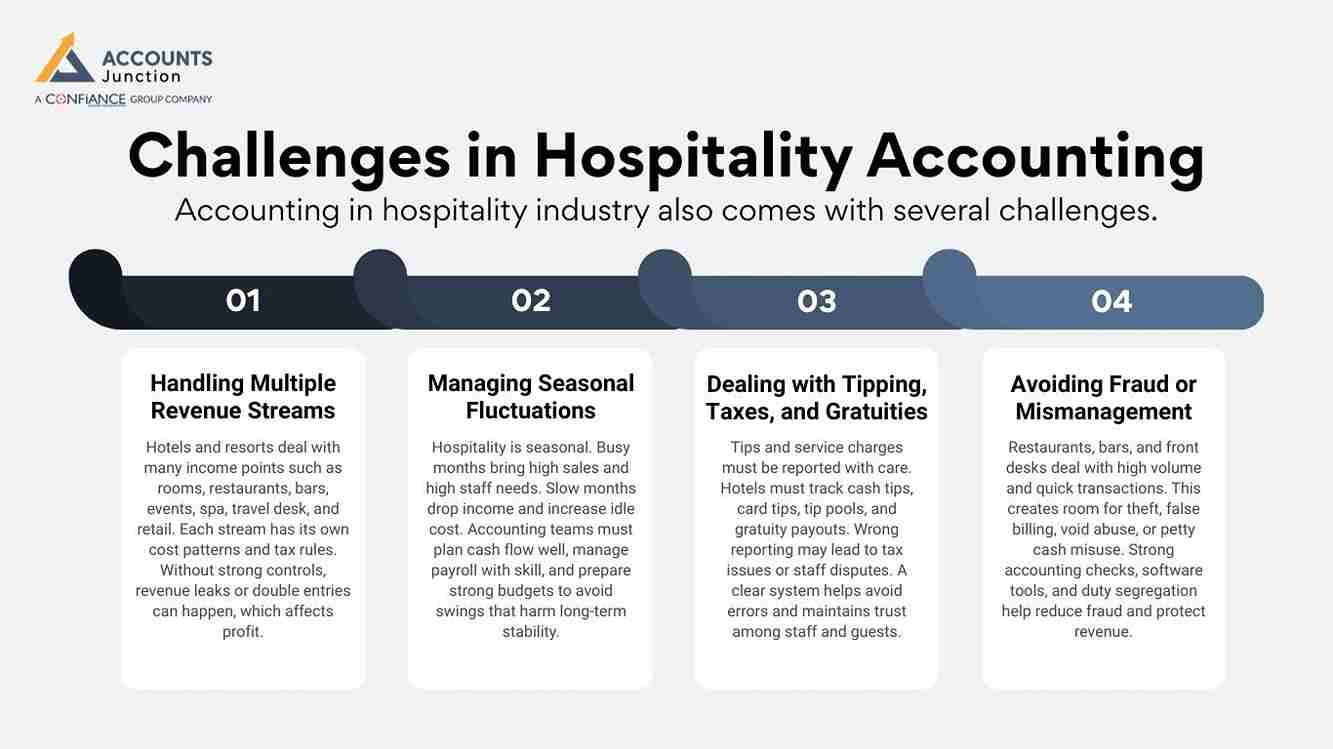
Accounting in hospitality industry also comes with several challenges:
1. Handling Multiple Revenue Streams
Hotels and resorts deal with many income points such as rooms, restaurants, bars, events, spa, travel desk, and retail. Each stream has its own cost patterns and tax rules. Without strong controls, revenue leaks or double entries can happen, which affects profit.
2. Managing Seasonal Fluctuations
Hospitality is seasonal. Busy months bring high sales and high staff needs. Slow months drop income and increase idle cost. Accounting teams must plan cash flow well, manage payroll with skill, and prepare strong budgets to avoid swings that harm long-term stability.
3. Dealing with Tipping, Taxes, and Gratuities
Tips and service charges must be reported with care. Hotels must track cash tips, card tips, tip pools, and gratuity payouts. Wrong reporting may lead to tax issues or staff disputes. A clear system helps avoid errors and maintains trust among staff and guests.
4. Avoiding Fraud or Mismanagement
Restaurants, bars, and front desks deal with high volume and quick transactions. This creates room for theft, false billing, void abuse, or petty cash misuse. Strong accounting checks, software tools, and duty segregation help reduce fraud and protect revenue.
Case Studies / Real-World Examples
Example: Hotel Chain Reduces Costs with Better Accounting
A mid-size hotel chain saw rising food and labor costs across its properties. By adopting a unified accounting software, the chain tracked recipe cost, room cost, and staff use across all units. Data showed that two properties had waste due to poor portion control, and three had high overtime due to poor shift planning. With new cost rules and clear dashboards, the chain cut food cost by 12 percent and labor cost by 8 percent in six months. Profit per room went up even in a soft season.
Example: Resort Improves Profit Through Revenue Insights
A resort added a system that linked its front desk, restaurant POS, spa billing, and event bookings. This revealed peak guest spending times and best-selling services. By adjusting room package prices and promoting spa deals during quiet hours, the resort increased total guest spend by 15 percent without raising base rates.
Why Choose Accounts Junction for Hospitality Accounting
Accounts Junction offers end-to-end accounting support for hotels, restaurants, cafes, resorts, and event spaces. Our team understands the fast and high-volume nature of this industry. We help you handle daily revenue checks, food cost control, payroll, tip tracking, vendor bills, GST returns, and clean monthly reports. We use cloud tools that fit the hospitality workflow and keep your numbers clear and ready at all times.
With Accounts Junction, you get:
- Accurate financial and managerial reports
- Real-time cost and revenue dashboards
- Clean tip and gratuity management
- Fraud risk checks
- Seasonal budgeting and cash flow plans
- Support for audits, tax filings, and system setup
We help you run a smoother operation while you focus on guest service.
Inventory Control: Avoiding Stale Ingredients
Inventory in a restaurant or hotel is more than just things on a shelf; it's an investment. Accounting assists in the efficient management and control of inventories, the prevention of waste, and the optimal utilization of resources. This not only saves money but also assures that clients receive fresh and high-quality products, improving their overall experience.
Performance Analysis: Learning from the Past to Shape the Future
Accounting is more than simply statistics; it is about presenting the tale of a company's journey. Businesses can use performance analysis to reflect on past successes and challenges, learning useful lessons that will inform future plans. This introspection enables organizations to respond to market trends and changing customer preferences, allowing for ongoing progress.
Investor Confidence: Building Trust and Attracting Investment
Attracting investors is typically a critical step for hospitality firms trying to expand or improve. Accurate and transparent financial records, made possible by sound accounting standards, foster trust among prospective investors. This trust serves as the basis for successful collaborations and financial assistance.
We have several years of experience in accounting in hospitality industry. We have helped many hotels, resorts, restaurants, and cafes around the world with our remote accounting services. If you want to manage your financial information more easily, contact Accounts Junction, and get a wide range of additional bookkeeping and accounting services in a variety of industries.
FAQs
1. What is hospitality accounting?
- It is the process of tracking income, cost, and financial activity in hotels, restaurants, and resorts.
2. Why is accounting important for hotels?
- It helps manage cash flow, prevent loss, and track profit across many revenue points.
3. How is hospitality accounting different from normal business accounting?
- It deals with daily sales, many service points, tipping, and room-based metrics like occupancy and ADR.
4. What does a front-office accountant do?
- They match room sales, guest folios, POS reports, and deposits to ensure clean revenue records.
5. What is RevPAR?
- It stands for revenue per available room and shows how well a hotel uses its room inventory.
6. What is food cost percentage?
- It measures how much of each food sale goes into buying ingredients.
7. How do hotels track tips and service charges?
- With POS systems, tip sheets, and payroll rules that show what each staff member must receive.
8. Why do hotels face fraud risk?
- High volume, cash use, and fast service create chances for misuse without strong checks.
9. How can software help hotels?
- It links booking systems, POS, and accounting to reduce errors and save time.
10. What is managerial accounting used for in hospitality?
- It helps plan budgets, track cost trends, and support daily decisions.
11. Why do hotels struggle with seasonal changes?
- Guest demand shifts each month, which impacts room sales and staffing needs.
12. What is cost accounting in hospitality?
- It tracks food, beverage, labor, and overhead to control waste and improve margin.
13. What is a night audit?
- A daily end-of-day check that matches all sales with system records.
14. Why do restaurants need accounting support?
- They deal with waste, vendor bills, cash tips, and daily sales that need tight tracking.
15. What are common revenue leaks in hotels?
- Wrong postings, void misuse, unbilled guests, and poor inventory control.
16. How do hotels set menu prices?
- They use recipe cost, demand data, and profit rules to set fair prices.
17. What reports do hotel owners need?
- Income statements, cash flow reports, occupancy data, food cost reports, and revenue summaries.
18. Why is payroll tricky in hospitality?
- Shifts change often, overtime rules vary, and tips affect staff pay.
19. Can outsourced accounting help small hotels?
- Yes, it cuts cost and gives them expert support without hiring a full team.
20. Why choose Accounts Junction?
- We offer accounting with industry-specific tools, clear reports, strong controls, and full accounting support for all hospitality units.