What is the role of accounting in healthcare business?
The healthcare industry now has to keep a proper accounting to ensure financial efficiency. There are some important economic components in the healthcare industry whether it is a small or large organization. These can be related to patient payments, insurance, government schemes, etc. It is only a proper healthcare accountant, who can help you bring better efficiency in the accounting for your healthcare organization. Although the accounting method would be the same in healthcare accounting like general accounting, the approach will be different. Accounting in healthcare business will help to bring efficient cashflow management.
How can an expert healthcare accountant help to improve healthcare business?
Accounting in the healthcare business must be done with the proper approach to ensure financial efficiency. Here are some importance of healthcare accounting:
Efficient financial management
Accounting helps healthcare organizations manage their finances effectively. This includes forecasting, budgeting, and financial planning. This will ensure that resources are allocated efficiently and that the organization remains better with finances.
Cost Control
Healthcare costs can be significant and accounting helps in tracking these costs. By analyzing expenses, healthcare organizations can identify areas where costs can be reduced without compromising the quality of care. It will help in saving costs and maintain better financial stability.
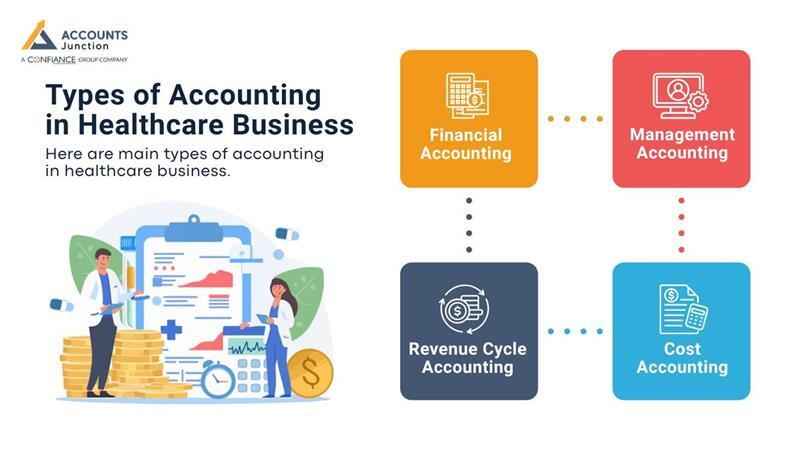
Types of Accounting in Healthcare Business
Here are main types of accounting in healthcare business:
Financial Accounting
Financial accounting deals with the reports that go out to people outside the setup. This includes investors, boards, lenders, and other key groups. The goal is to keep clear and fair records that show how the health unit stands at the end of each term. It sums up income, spend, assets, and debt in a clean way. These reports build trust. They also help outside groups judge the long term health of the unit.
Management Accounting
Management accounting helps the leaders run the day to day work. It gives them real time views of cost, use of staff, and the flow of cash. It guides the team on what to cut, what to grow, and where to shift care lines. It also helps plan budgets, set prices for care, check trends, and spot waste.
Cost Accounting
Cost accounting tracks each cost that comes up in care. This may be staff cost, device cost, room cost, or drug cost. This helps health units see the true spend of each line of care. With this, they can trim waste, raise profit, set fair rates, and keep the whole system lean.
Revenue Cycle Accounting
Revenue cycle accounting deals with each step of the bill flow. It starts when the patient books a visit and ends when the last due sum comes in. It tracks claims, checks if data is clean, speeds up pay cycles, and cuts claim denials. It links with insurance firms to make sure the unit gets paid on time.
Challenges in Healthcare Accounting
Accounting in healthcare business has to be dealt with several challenges. Here are some of them:
Handling Complex Insurance Claims and Reimbursements
Claims in the health space are tough due to long codes, deep rules, and case-based pay plans. Small gaps in data can lead to a claim denial. Fixing these issues takes time and slows cash flow.
Navigating Regulatory Requirements (HIPAA, ACA, GAAP)
Health units must stay in line with many laws. HIPAA sets rules for data safety. ACA adds rules for care and cost limits. GAAP guides how books must be kept. The mix of all these rules makes the job hard and calls for high skill and sharp checks.
Managing High Operational Costs and Unpredictable Cash Flows
Health units often face high cost of staff, tools, labs, and tech. Since claims may get paid late or in parts, the cash flow can jump up and down with no clear trend.
Risk of Fraud or Billing Errors
Wrong codes, false claims, or human errors can cause big loss. Fraud checks, audits, and clean systems are key to keep the work safe and in line.
Why Choose Accounts Junction for Healthcare Accounting
Here’s why you should choose Accounts Junction for accounting in healthcare business:
Expertise in Healthcare Finance
We know the deep parts of health rules, claim cycles, and audit needs. Our team works with clinics, labs, care homes, and large health units.
Accurate, Clean, and Fast Books
We keep your books clean and up to date with clear checks and smart tools. This helps you trust your numbers and plan your next steps with ease.
Full Support for Revenue Cycle
We track claims, fix denials, speed up pay cycles, and help you get steady cash flow. Our goal is to make the whole bill chain smooth so you can focus on care, not on admin load.
Cost Control and Better Cash Flow
With sharp cost checks, strong spend reports, and lean systems, we help you save more and run more smoothly. You see where money leaks out and where you can gain more.
Compliance and Data Safety
We keep your books in line with HIPAA, ACA, and GAAP. We use safe tech so your data stays in the right hands at all times.
End-to-End Healthcare Accounting Services
From payroll to tax to audits to claims, we handle it all. You get one smooth team that knows your work and stays with you as you grow.
Billing and revenue cycle management
Billing and receiving payments is one of the important aspects of every business. Proper accounting practices are essential for accurate billing and revenue cycle management. This includes recording patient services, ensuring timely payments are received, and submitting claims to insurance companies.
Compliance fulfillment
Healthcare organizations must adhere to various regulations and standards, including financial reporting requirements. Expert healthcare accountants can ensure compliance with laws such as the Health Insurance Portability and Accountability Act (HIPAA) and the Affordable Care Act (ACA). They must also meet financial reporting standards set by regulatory bodies.
Better decision making
Proper decision-making is very essential for the healthcare industry. Accounting provides the financial data necessary for informed decision-making by healthcare managers and executives. This includes assessing the financial viability of new services or investments and evaluating the performance. This will also help in determining better pricing strategies.
Auditing
Regular audits are conducted to ensure the integrity and accuracy of financial records in healthcare organizations. Accounting practices help to maintain both internal and external accountability and transparency of the healthcare organization.
Financial Reporting
Healthcare organizations are required to prepare financial statements for various stakeholders, including creditors, investors, and regulatory agencies. Quality healthcare accounting ensures that these financial reports are reliable, accurate, and comply with all the standards.
Allocation of the resources
Healthcare organizations often face competing demands for resources and allocation of it is a challenge. Accounting helps to prioritize these demands by providing insights into the costs and benefits of different initiatives.
These are some of the roles of accounting for the healthcare business. Accounting in the healthcare industry involves a comprehensive approach to managing finances while ensuring better financial efficiency.
If your healthcare industry is finding it difficult to manage the accounting then you can outsource it to the expert healthcare accountant. Accounts Junction has a lot of experience in healthcare accounting working for various healthcare organizations. Our team has successfully managed the complicated aspects of accounting in healthcare business and brought financial efficiency. Accounts Junction is a prominent accounting service-providing company for healthcare business.
FAQs
1. What is healthcare accounting?
- It is the process of tracking, reporting, and managing the money side of health units.
2. Why is accounting in healthcare business more complex than normal accounting?
- Due to claims, codes, strict laws, and long pay cycles.
3. What does a healthcare accountant do?
- They track spend, income, claims, budgets, and help with rules and audits.
4. What is revenue cycle accounting?
- It is the full chain from patient visit to final payment received.
5. Why do claims get denied?
- Wrong data, wrong codes, late files, or gaps in patient info.
6. How can a clinic cut claim denials?
- By clean data entry, sharp checks, and fast follow up on issues.
7. What is HIPAA in healthcare accounting?
- A law that sets rules for data safety and patient info.
8. How does GAAP apply to healthcare?
- It sets the rules for how books must be done and kept.
9. Why is cash flow a big issue in healthcare?
- Bills take long to get paid and claims may get stuck or denied.
10. What is cost accounting in healthcare?
- It tracks the real cost of care lines so the unit can set fair rates and cut waste.
11. How can healthcare units cut costs?
- Through cost checks, lean use of staff, smart buy plans, and tech.
12. Why do health units need management accounting?
- It helps them make fast and smart choices with real time data.
13. Do small clinics also need healthcare accounting?
- Yes, as they also deal with claims, rules, and spend.
14. Can healthcare accounting prevent fraud?
- It helps spot odd trends, wrong claims, and wrong spend.
15. What tools are used in healthcare accounting?
- EHR systems, claim tools, billing tools, and cloud books.
16. Why outsource healthcare accounting?
- It saves time, cuts errors, and brings expert skill.
17. What is a healthcare audit?
- A deep check of records, claims, and spend to make sure all is right.
18. How does Accounts Junction help with audits in healthcare business?
- We prepare your books, fix gaps, and guide you through the full audit.
19. Can Accounts Junction help with tax in healthcare business?
- Yes, we handle tax plans, tax files, and tax checks for health units.
20. Why pick Accounts Junction over others for accounting in healthcare business?
- Our experience and expertise in accounting for healthcare business places us at the top picks.